


Login to view your Fidelity account(s) and access your electronic documents and statements.

Login to view your Charles Schwab account(s) and access your electronic documents and statements.
Quarterly Investment Foundations Second Quarter 2026
April 16, 2026
-
Calvin D. Wiersma
Calvin D. Wiersma
MST, CFP®
Senior Financial Advisor, Director of Planning and Investments

Market Check-In
The first quarter of 2026 was quiet until it wasn’t. Initially, U.S. and non-U.S. stocks continued their 2025 momentum reaching all time highs in late February. This momentum was halted by spiking energy prices stemming from the war in Iran as broad indexes pulled back to roughly flat on the year by the end of March. Interest rates also rose with concerns of persistent inflation leaving bonds down for the quarter.
While we’d typically leave things there, in the two weeks following the quarter end, peace talks and a ceasefire agreement in the Middle East drove optimism and a major recovery in stock prices with global indexes once again approaching all time highs. The table below summarizes asset class performance results as of April 15, 2026. We’ve included year-to-date returns to provide a clear picture of how much markets have moved since quarter end.
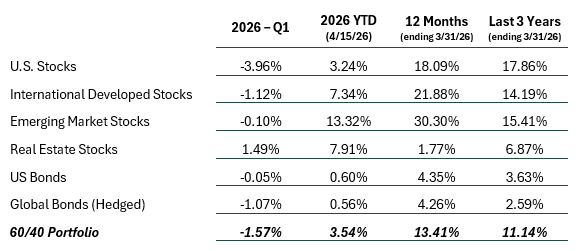
Data as of 4/15/2026. Past Performance is no guarantee of future results. U.S. Stocks, International Developed Stocks, Emerging Market Stocks, Real Estate Stocks represented by Russell 3000, MSCI World ex USA, MSCI Emerging Markets, and Dow Jones US Select REIT indices. U.S. bonds and Global bonds represented by the Bloomberg U.S and Global Aggregate indices. The 60/40 Portfolio refers to a portfolio that holds 60% stocks and 40% bonds and is a calculated representation of the categories and their performance noted above.
Although we can’t know what will happen next geopolitically or how long energy prices will be elevated, we can rely on portfolio construction fundamentals to get through this period. Diversification continues to be important, and patience - perhaps now more than ever - will be key to staying disciplined as we are likely to experience more volatility. Even at the late March lows, zooming out showed a brighter picture with returns over the last year and three years still well above historical averages.
Times of volatility are good opportunities for investors to review their portfolio allocation to make sure it is appropriate for their situation and is positioned to navigate uncertainty. By building a globally diverse portfolio and one that emphasizes factors that increase potential return, investors can have confidence that they are capable to seeing this event and the next one through.
Adding Something Small to the Mix
Salt is one of the most important ingredients in almost any recipe, yet it only represents a small portion of the entire dish. Adding a small amount of salt brings out the other flavors and without it, food tastes flat. While investing and cooking are quite different, the importance of adding small amounts of important ingredients to make the end results shine is one thing they have in common.
As investors, it’s easy to gravitate toward the largest, most recognizable companies after a period of strong performance. However, a well-constructed portfolio looks beyond what has worked recently and focuses on long-term drivers of return.
Just as when you are making your favorite recipe, it can be easy to overlook the smallest ingredients for the larger ones. Large U.S. companies have outperformed in the past few years, reinforcing a natural recency bias to dismiss the importance of small company stocks. Yet adding a dash of small company stocks to a portfolio can increase diversification and long-term potential return. With elevated valuations and increased concentration in a handful of dominant stocks, including small company stocks is even more important, in our view.
Small Company Stock Premium
Small company stocks represent a critical component of a diversified investment strategy. While they make up roughly 10% of the U.S. equity market, history shows they have delivered higher returns than their large company counterparts by approximately 1.7% annually since 1928. This return premium is not unique to U.S. stocks; it has also been observed in international markets, often to an even greater degree. This pattern is consistent with the concept of highly efficient markets, where higher potential returns are tied to securities with higher levels of risk. Smaller companies tend to carry greater uncertainty and volatility, and investors have historically been compensated for bearing that additional risk.

Source: Dimensional Fund Advisors
Writing the Recipe
At Grand Wealth Management, we intentionally include small company stocks across both U.S, international developed and emerging market portfolios. In practice, this means allocating slightly more than the market weights to small company stocks. This measured overweight allocation reflects our conviction in the long-term return premium associated with smaller companies while maintaining a disciplined, diversified approach. Grounded in decades of data and thoughtful portfolio construction, we believe this allocation positions investors to capture broader market opportunities and improve outcomes over time.
In investing, focusing on what has worked best lately is no guarantee of what will work best next. Just as in cooking, incorporating the small but important ingredients creates a better outcome. Even though small companies are only a small portion of the overall market, including them in a portfolio is a foundational way to create better potential outcomes for long-term investors.
Disclosure:
The opinions expressed herein are those of Grand Wealth Management (“GWM”) and are subject to change without notice. This material is not financial advice or an offer to sell any product. This article is for informational purposes only and does not constitute investment, legal or tax advice and should not be used as a substitute for the advice of a professional legal or tax advisor. GWM reserves the right to modify its current investment strategies and techniques based on changing market dynamics or client needs. This is not a recommendation to buy or sell a particular security. Past performance does not indicate future results. GWM is an independent investment adviser registered under the Investment Advisers Act of 1940, as amended. Registration does not imply a certain level of skill or training. More information about GWM including our investment strategies, fees and objectives can be found in our Form ADV Part 2 and Form CRS, which are available upon request.
